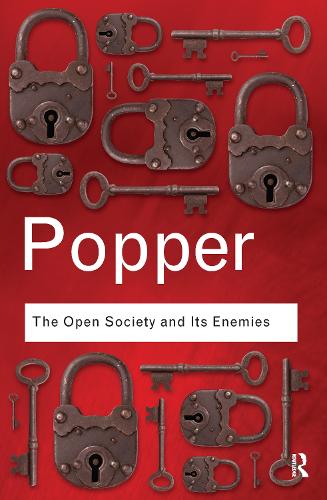
The Open Society and Its Enemies

The Open Society and Its Enemies cover
Good Books rating 4.37
Technical
  • ID: 8539
  • Added: 2025-12-22
  • Updated: 2025-12-30
  • ISBN: 9780415282369
  • Publisher: Psychology Press
  • Published: 2002-01-01
  • Formats: 3
  • Reviews: 3

Karl Popper's seminal work, 'The Open Society and Its Enemies,' is a profound critique of the philosophies of Plato, Hegel, and Marx. Popper argues that these thinkers' utopian visions have led to totalitarian regimes and the suppression of individual freedoms. His analysis is not just a historical account but a warning about the dangers of political engineering and the importance of an open society where criticism and debate are encouraged./n/nPopper's work is a testament to the power of critical thinking and the importance of intellectual freedom. It is a must-read for anyone interested in political philosophy, history, and the future of democracy. The book's insights are as relevant today as they were when first published, making it a timeless contribution to the field of political thought.

Reviews
Amazon · 2025-12-22
best 4.60

The book is praised as one of the best statements of classical liberalism, offering a sustained critique of Plato's social philosophy.

The reviewer praises the book as one of the best statements of classical liberalism, highlighting its sustained critique of Plato's social philosophy. They appreciate the book's clarity and depth, making it a valuable contribution to political theory. The work is seen as a timeless critique of authoritarian philosophies and a vision for an open society. The reviewer emphasizes the book's relevance and its ability to provide a comprehensive understanding of the principles of liberalism.


Quick quotes

    This book, written as a sustained critique of the social philosophy of Plato, is one of the best statements of classical liberalism I have encountered.

    The book's clarity and depth make it a valuable contribution to political theory.

    It provides a timeless critique of authoritarian philosophies and a vision for an open society.

classic 4.00

The book is described as a classic of liberal thought that analyzes totalitarianism and anticipates the struggle between free-market liberalism and socialism.

The reviewer describes the book as a classic of liberal thought, emphasizing its analysis of totalitarianism and its anticipation of the struggle between free-market liberalism and socialism. They appreciate the book's enduring relevance and its ability to provide a comprehensive critique of authoritarian philosophies. The work is seen as a foundational text for understanding the principles of an open society and the dangers of totalitarianism. The reviewer highlights the book's intellectual depth and its continued importance in contemporary political discourse.


Quick quotes

    It is a classic of liberal thought which analyses the workings of totalitarianism and anticipates the struggle between free-market liberalism and socialist or authoritarian philosophies.

    It provides a comprehensive critique of authoritarian philosophies and a vision for an open society.

    The book's intellectual depth and continued importance in contemporary political discourse are highlighted.

The Guardian · 2016-09-26
impressive 4.50

The book is praised for its rhetorical force and clarity, making it a singular and impressive work. It remains highly relevant and essential reading.

The reviewer highlights the rhetorical force and clarity of Popper's writing, which makes the book both singular and impressive. They emphasize that the book's insights are as relevant today as they were at the time of publication. The work is seen as a timeless contribution to political philosophy, offering a profound critique of totalitarianism and a vision for an open society. The reviewer appreciates the book's ability to anticipate and address contemporary issues, making it a must-read for anyone interested in political theory.


Quick quotes

    With hindsight, it's the rhetorical force and clarity of Popper's writing that is both singular and impressive.

    It remains highly readable, erudite and lucid and as essential reading today as on publication in 1945.

    It is available here in a special centenary single-volume edition.