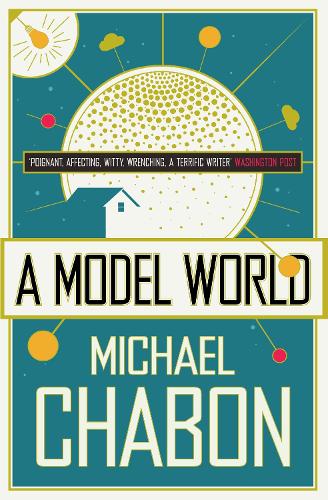
A Model World and Other Stories by Michael Chabon is a collection of short fiction that offers a glimpse into the author's early career. The book is divided into two parts. The first part, 'A Model World,' features six stories about young adults grappling with love and the search for meaning in their lives. The second part, 'The Lost Word,' follows the life of Nathan Shapiro, focusing on the impact of his parents' divorce. The stories are emotionally rich and well-crafted, with Chabon's signature descriptive style. However, some readers may find the stories a bit thin on plot and action, as they primarily focus on moments in time rather than full narratives. The collection is a testament to Chabon's skill as a writer, but it may leave readers wanting more depth and resolution. The stories are enjoyable and thought-provoking, but they often feel like preview chapters to a larger novel that never materializes. Despite this, the collection is a worthwhile read for fans of Chabon's work and those interested in his early writing style.
Quick quotes
He stood in the middle of the half-empty room for a minute or so, until his glance fell on a wastebasket that stood beside the space where his father’s desk has been. It was mostly full of shit cardboard and the white wrappers of coat hangers, but at the bottom he spied a crumpled yellow ball of legal paper, which he fished out and spread flat on the floor. It was some kind of a list, made by his father, and Nathan knew at one that it was a secret list, and that after he had finished reading it he would probably wish he hadn’t, as he was continually pained by the memory of a love letter he had found in a box in the basement, written to his father by a girl who had once been Nathan’s favourite baby-sitter. He lay on his stomach in the space where there was no longer a great, oaken desk and read what his father had set down. The handwriting was neat and restrained, as though Dr. Shapiro had been angry while he wrote.
My friend Levine had only a few months to go on his doctoral dissertation, but when, one Sunday afternoon at Acres of Books, he came upon the little black paperback by Dr. Frank J. Kemp, he decided almost immediately to plagiarize it. It was lying at the bottom of a whiskey crate full of old number of the Evergreen Review, which he had been examining intently because he was trying to get a woman named Betty, who liked the poetry of Gregory Corso, to fall in love with him; he was overexuberant and unlucky in love and had just resolved — for example — to grow some beatnik facial hair. The little book was marked on the outside neither from nor back; it was a plain, black square. Levine picked it up only because he had been lonely for a long time and he idly hoped, on the basis of its anonymous cover, that it might contain salacious material. When he opened it to its title page, he received an indelible shock. “Antarctic Models of Induced Nephokinesis,” he read. This was the branch of meteorological engineering he was concerned with in his own research — in fact, it was the very title he had chosen for his dissertation.
The other reason I don’t have a problem with Chabon’s penchant for writerly flourishes is that he’s good at them. It also helps that the book is a little slim. The stories are of a nice length, never feeling like they overstay their welcome. They’re all enjoyable to read (save one or two) but by the time they end you’ll have a hard time telling a friend what the story was about. That’s because these stories convey emotions better than they convey action or plot or even what would traditionally be called a story.