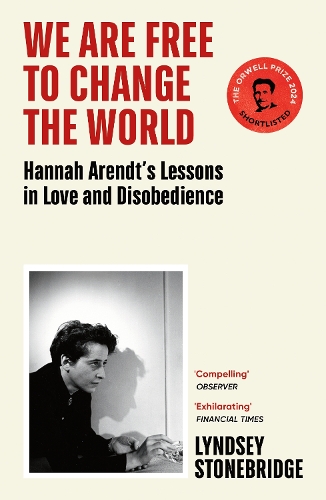
We Are Free to Change the World: Hannah Arendt’s Lessons in Love and Disobedience

We Are Free to Change the World: Hannah Arendt’s Lessons in Love and Disobedience cover
Good Books rating 4.17
Buy online
Technical
  • ID: 6015
  • Added: 2025-10-29
  • Updated: 2025-10-31
  • Formats: 1
  • Reviews: 3
Reviews
literaryreview.co.uk · Unknown · 2025-11-15
intriguing 3.50

Lyndsey Stonebridge's book explores Hannah Arendt's insights into evil through her coverage of the Eichmann trial, highlighting Arendt's unique perspective on the banality of evil and her philosophical approach to understanding moral and political issues. The book blends biography with a meditation on Arendt's relevance today, though some of Stonebridge's imaginative interpretations may confuse readers.

Lyndsey Stonebridge's book delves into Hannah Arendt's groundbreaking work on the Eichmann trial, where Arendt famously coined the phrase 'the banality of evil.' Stonebridge argues that Arendt's perspective was unique, seeing Eichmann not as a monster but as a man lacking moral awareness. The book is part biography and part philosophical exploration, examining Arendt's relevance in today's political climate, especially in the context of populism and totalitarianism. Stonebridge's approach includes imaginative interpretations of Arendt's thoughts and experiences, which, while sometimes confusing, offer a fresh perspective on Arendt's ideas. The book also highlights Arendt's Kantian influences and her concept of 'enlarged mentality,' though her application of this concept in real-life situations, such as the civil rights movement, sometimes fell short.


Quick quotes

    Stonebridge writes, 'Arendt saw an ancient crime in modern garb, and portrayed Eichmann as the latest monster in the long history of anti-Semitism who had simply used novel methods to take hatred for Jews to a new level.

    Arendt wrote: 'The longer one listened to him, the more it became obvious that his inability to speak was closely connected to his inability to think, namely to think from the standpoint of somebody else.

    Stonebridge claims justification for her method by citing how Arendt was committed to what Immanuel Kant called 'an enlarged mentality'.

revdem.ceu.edu · Unknown · 2024-09-06
insightful 4.50

The book offers a profound exploration of Hannah Arendt's philosophy, emphasizing love and disobedience as tools for change. It is praised for its insightful analysis and relevance to contemporary issues, making it a compelling read for those interested in political theory and activism.

We Are Free to Change the World delves into the philosophical teachings of Hannah Arendt, focusing on the themes of love and disobedience as catalysts for societal transformation. The book is lauded for its deep and thought-provoking examination of Arendt's ideas, which are presented in a manner that resonates with current political and social challenges. Readers will appreciate the author's ability to connect historical philosophy with modern-day activism, making the book both intellectually stimulating and practically relevant. The exploration of Arendt's concepts is not only academic but also deeply personal, inviting readers to reflect on their own roles in creating change. This book is a must-read for anyone interested in political theory, philosophy, and the power of individual action in shaping the world.


Quick quotes

    Hannah Arendt's philosophy is a beacon of hope for those seeking to understand the complexities of love and disobedience.

    The book's relevance to contemporary issues makes it a compelling read.

    The author's ability to connect historical philosophy with modern-day activism is truly inspiring.

australianbookreview.com.au · Unknown · 2024-05-26
insightful 4.50

We Are Free to Change the World by Lyndsey Stonebridge explores Hannah Arendt's life and political thought, offering insights into addressing modern authoritarianism. The book emphasizes the importance of independent thinking and human experience in combating political discontentment. Stonebridge argues that Arendt's ideas are crucial for understanding and responding to contemporary threats to democracy, highlighting the need for political freedom and active participation.

Lyndsey Stonebridge's We Are Free to Change the World provides a compelling exploration of Hannah Arendt's life and political thought, framed within the context of modern political discontentment. The book is intellectually stimulating yet accessible, compelling readers to reflect critically on how Arendt's lessons apply to today's threats to democracy. Stonebridge argues that Arendt's work offers valuable insights into addressing authoritarian tendencies in contemporary politics, emphasizing the importance of independent thinking and human experience. The author intertwines Arendt's personal story with her political thought, covering the philosophers and theorists who influenced her and her major works. Stonebridge draws parallels between Arendt's examples of Nazi Germany and McCarthyism and current political affairs, highlighting elements that contribute to authoritarianism. She argues that Arendt's belief in the power of individual thinking and plurality is crucial for maintaining political freedom. The book suggests the need for political participation, civil disobedience, and genuine revolution to demand rights and freedoms. However, the book's strength lies in its detailed build-up of Arendt's ideas, while its weakness is the overwhelming amount of detail and intricacy that sometimes makes it tough to follow.


Quick quotes

    In the book, Stonebridge draws out how, by following Arendt, we can respond to the challenges posed by the populist authoritarianism of our current political leaders, namely by encouraging independent thinking that is framed by human experience.

    Who writes the plots of totalitarianism, Hannah? she asked. Nobody, was Arendt’s answer. This is why totalitarianism was profoundly anti-political: in the end, there were no opinions, no debates, no agency, no…people.” (p.219)

    Real freedom — and I have come to think this is Arendt’s central political insight — requires the presence of others so that we can test our sense of reality against their views and lives, make judgement, probe and learn” (p.300)

Appears in Lists