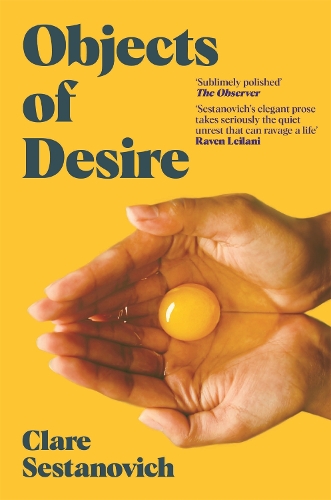
Objects of Desire

Objects of Desire cover
Good Books rating 4.05
Buy online
Technical
  • ID: 3830
  • Added: 2025-10-20
  • Updated: 2025-10-21
  • Formats: 1
  • Reviews: 4
Reviews
bookmarks.reviews · Unknown · 2025-10-21
brilliant 4.20

Objects of Desire is a collection of stories that explore the complexities of relationships, desire, and the mundane aspects of life. The stories are praised for their precise prose, emotional depth, and the way they capture the nuances of human experiences.

Objects of Desire by Clare Sestanovich is a collection of stories that delve into the gray areas of emotion and the power dynamics within relationships. The stories are tightly crafted, focusing on the most meaningful moments in the lives of the characters. Sestanovich's prose is precise, and she has a knack for drawing out subtle emotional responses. The collection is praised for its exploration of the complexities of desire and the mundane aspects of life, with characters often suffering for the benefit of others. The stories are noted for their structural beauty and the way they capture the discontinuities and incomplete causes and effects in lives. The collection is also admired for its ability to subvert conventional story structure while building a story with its own order.


Quick quotes

    The images that close...stories can have this kind of poetic reach, this upward tilt. If they sometimes feel a little strained, there’s a structural beauty, a hidden order 'containing' the wandering episodes. A remarkable talent is at work here.

    The exactness of such passages is elating. But readerly impatience can sometimes arise. This has to do with which experiences are stressed, which angles we get to view these characters’ lives from.

    The stories contain plot insomuch as real life contains plot: we make sense and meaning out of what we're given.

chireviewofbooks.com · Unknown · 2025-10-21
captivating 4.50

Objects of Desire is a captivating exploration of the intersection between art and desire, delving into the complexities of human emotions and the objects that symbolize them. The book offers a unique perspective on how art can evoke deep emotional responses and the power it holds in shaping our understanding of desire.

Objects of Desire is a thought-provoking book that delves into the intricate relationship between art and human desire. The author masterfully weaves together various art forms to illustrate how objects of desire can evoke a range of emotions, from longing to fulfillment. They highlight the transformative power of art in shaping our perceptions and understanding of desire, making it a compelling read for anyone interested in the intersection of art and psychology. The book's exploration of different art forms and their emotional impact is particularly noteworthy, as it provides a fresh perspective on a timeless theme. The author's insights are both profound and accessible, making the book enjoyable for both casual readers and art enthusiasts alike.


Quick quotes

    The objects we desire are not just things, but symbols of our deepest longings and aspirations.

    Art has the power to evoke emotions that words alone cannot capture, making it a unique medium for exploring the complexities of desire.

    The transformative power of art lies in its ability to shape our understanding of the world and our place in it.

the-tls.com · Unknown · 2025-10-21
intriguing 3.50

Clare Sestanovich's debut short story collection, Objects of Desire, features young women adrift in life, navigating relationships and personal struggles. The stories embrace ambiguity and discontinuity, reflecting real-life experiences that often lack clear resolutions.

Clare Sestanovich's debut short story collection, Objects of Desire, introduces readers to a cast of young women who are adrift in the world, transiting between homes, schools, affairs, and marriages. The stories are characterized by a lack of traditional narrative structure, focusing instead on the complexities and ambiguities of modern life. The characters, such as Iris, Georgia, and Kate, find themselves in situations that are often unresolved, mirroring the real-life experiences that rarely fit neatly into a plot pyramid. The collection's strength lies in its embrace of ambiguity and its refusal to conform to conventional storytelling, making the stories feel real and appropriately vexing. The final story, 'Separation,' provides a more dramatic narrative but still withholds a clear resolution, leaving readers to ponder the open-ended nature of the characters' lives.


Quick quotes

    Few stories in Objects of Desire constitute a narrative in a traditional sense, and that’s by design.

    The stories here often proceed digression by digression rather than plot point by plot point.

    Sestanovich’s choice to embrace ambiguity and irresolution that makes these stories real-feeling and appropriately vexing.

harvardreview.org · Unknown · 2021-08-31
good 4.00

Objects of Desire explores the power dynamics in relationships, often showing women bearing the emotional burdens while men escape consequences. The collection is praised for its precise prose and subtle emotional depth, highlighting the gray areas of human relationships.

Objects of Desire by Clare Sestanovich delves into the complex power dynamics between men and women in relationships. The stories often depict women struggling to find agency and bearing the emotional and literal burdens, while men frequently escape without significant consequences. The collection is noted for its precise prose and ability to draw out subtle emotional responses, even as it crafts broader narratives. The women in these stories have dreams that go unfulfilled, while the men's desires are often effortlessly achieved. Betrayal is a recurring theme, with men often seeking to satisfy their needs at the cost of the women in their lives. The collection is praised for its tightly crafted stories and the author's skill in winnowing narratives into the most meaningful moments in the lives of her characters.


Quick quotes

    The men primarily escape without consequence while the women bear the emotional and literal burdens the characters confront in these stories.

    The women in Sestanovich’s stories have dreams that go unfulfilled, while the men have — dreams is too generous a word — desires that are usually effortlessly achieved.

    The strengths of Sestanovich’s stories lies in finding these subtle ways to have characters betray each other.