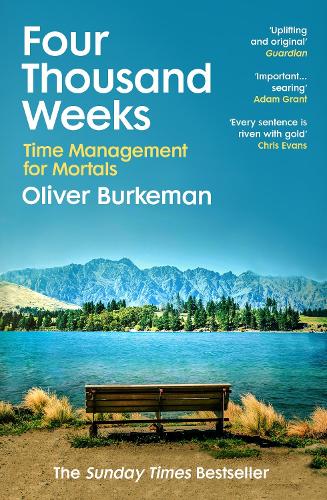
Four Thousand Weeks: Time Management for Mortals

Four Thousand Weeks: Time Management for Mortals cover
Good Books rating 4.5
Buy online
Technical
  • ID: 3273
  • Added: 2025-10-17
  • Updated: 2025-10-17
  • Formats: 1
  • Reviews: 4
Reviews
reddit.com · Unknown · 2025-10-20
insightful 4.50

Four Thousand Weeks challenges traditional productivity advice by emphasizing the finite nature of time and the importance of focusing on what truly matters. It encourages readers to embrace imperfection and prioritize meaningful experiences over constant busyness.

Oliver Burkeman's Four Thousand Weeks offers a refreshing perspective on time management, urging readers to accept the limitations of their time and focus on what is truly important. Instead of striving for endless productivity, the book advocates for a more mindful and intentional approach to life. It suggests that by letting go of the pressure to do it all, we can find more fulfillment and joy in our daily experiences. The book's insights are particularly relevant in today's fast-paced world, where many people feel overwhelmed by the constant demand to be productive. By shifting our focus from quantity to quality, we can make the most of our limited time and create a more balanced and fulfilling life.


Quick quotes

    The idea that we can do it all is a myth

    We are not going to get everything done, and that's okay

    The key to a fulfilling life is not in doing more, but in doing what matters most

janicegreenwood.com · Unknown · 2025-10-20
thought-provoking 4.50

Oliver Burkeman's 'Four Thousand Weeks: Time Management for Mortals' offers a philosophical inquiry into life's brevity and the limitations of modern productivity. The reviewer found the book timely, as they had recently become overly efficient with checklists, realizing that this approach stripped away the joy and meaning from their activities. Burkeman argues that time management often leads to increased anxiety and emptiness, and the reviewer resonated with this perspective, acknowledging the privilege inherent in time management discussions.

Oliver Burkeman's 'Four Thousand Weeks: Time Management for Mortals' is a thought-provoking exploration of the limitations of modern productivity and the philosophical implications of life's brevity. The reviewer found the book particularly relevant as they had recently become overly efficient with checklists, which, while making them incredibly productive, also stripped away the joy and meaning from their activities. Burkeman argues that time management often leads to increased anxiety and emptiness, as people become slaves to productivity and ambition. The reviewer resonated with this perspective, acknowledging the privilege inherent in discussions about time management and the need for a more balanced approach to life. Burkeman's insights flow like water, offering a wise and compelling argument that time management is less about getting everything done and more about making conscious choices about what truly matters.


Quick quotes

    The world is bursting with wonder, and yet it’s the rare productivity guru who seems to have considered the possibility that the ultimate point of all our frenetic _doing_ might be to experience more of that wonder.

    The problem isn’t exactly that these techniques and products don’t work. It’s that they do work — in the sense that you’ll get more done… and yet paradoxically, you’ll only feel busier, more anxious, and somehow emptier as a result.

    The more we try to manage our time, the faster time slips away, the more anxious we get. We get more done, but we live less.

wordslikesilver.com · Unknown · 2025-02-10
profound 4.50

Four Thousand Weeks by Oliver Burkeman offers a profound exploration of our relationship with time, challenging modern productivity obsessions. The book encourages readers to embrace finitude and construct a meaningful life, resonating deeply with those who feel overwhelmed by time constraints and the pursuit of optimization.

Four Thousand Weeks by Oliver Burkeman is a transformative book that delves into our complex relationship with time. Burkeman argues that our modern obsession with productivity and efficiency often makes us feel more anxious and less fulfilled. Instead, he encourages readers to embrace the finite nature of life and focus on what truly matters. The book is filled with insights from various philosophers, psychologists, and spiritual teachers, making it both entertaining and profound. Burkeman's voice is authoritative yet humble, making the book accessible and engaging. The reviewer found the book particularly resonant, as it helped them shift their perspective on time and priorities. The book's exploration of topics like productivity, distraction, and the passage of time offers valuable insights for anyone feeling overwhelmed by the demands of modern life.


Quick quotes

    The real problem isn’t our limited time. The real problem — or so I hope to convince you — is that we’ve unwittingly inherited, and feel pressured to live by, a troublesome set of ideas about how to use our limited time, all of which are pretty much guaranteed to make things worse.

    The same goes for chores: in her book More Work for Mother, the historian Ruth Schwartz Cowan shows that when housewives first got access to 'labor-saving' devices like washing machines and vacuum cleaners, no time was saved at all, because society’s standards of cleanliness simply rose to offset the benefits; now that you could return each of your husband’s shirts to a spotless condition after a single wearing, it began to feel like you should, to show how much you loved him. 'Work expands so as to fill the time available for its completion,' the English humorist and historian C. Northcote Parkinson wrote in 1955, coining what became known as Parkinson’s law. But it’s not merely a joke, and it doesn’t apply only to work. It applies to everything that needs doing. In fact, it’s the definition of 'what needs doing' that expands to fill the time available.

    Heidegger next turns to humans specifically, and to our own particular kind of being. What does it mean for a human being to be? (I realize this is starting to sound like a bad comedy sketch about philosophers lost in wild abstractions. I’m afraid that’s going to get worse for another couple of paragraphs before it gets better.) His answer is that our being is totally, utterly bound up with our finite time. So bound up, in fact, that the two are synonymous: to be, for a human, is a
pigletinbed.com · Unknown · 2024-11-01
insightful 4.50

Four Thousand Weeks by Oliver Burkeman is a thought-provoking book that challenges conventional time management advice. It encourages readers to embrace imperfection and focus on what truly matters in life.

Four Thousand Weeks by Oliver Burkeman is a refreshing take on time management that eschews the typical productivity hacks and quick fixes. Instead, it delves into the philosophical and psychological aspects of time, urging readers to accept that they can't do it all. The book is filled with insightful observations and practical advice on how to prioritize and make the most of the limited time we have. It's a reminder that life is finite, and it's okay to let go of the idea of perfection. The writing is engaging and thought-provoking, making it a compelling read for anyone looking to reassess their approach to time management.


Quick quotes

    The book's central premise is that we can't do it all, and that's okay.

    It's a reminder that life is finite, and it's okay to let go of the idea of perfection.

    The writing is engaging and thought-provoking, making it a compelling read for anyone looking to reassess their approach to time management.