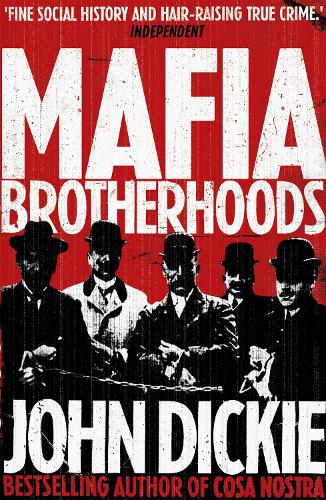
Mafia Brotherhoods: Camorra, mafia, 'ndrangheta: the rise of the Honoured Societies

Mafia Brotherhoods: Camorra, mafia, 'ndrangheta: the rise of the Honoured Societies cover
Good Books rating 3.83
Buy online
Technical
  • ID: 2896
  • Added: 2025-10-16
  • Updated: 2025-10-16
  • Formats: 1
  • Reviews: 3
Reviews
loot.co.za · Unknown · 2025-10-21
excellent 4.50

The book provides a comprehensive history of the mafia and its various branches, offering insights into their operations and influence. It is praised for its detailed research and engaging narrative, making it a valuable read for those interested in organized crime.

Mafia Brotherhoods delves into the origins and evolution of the Camorra, mafia, and 'ndrangheta, providing a thorough examination of their structures and activities. The author's meticulous research and vivid storytelling make the book both informative and compelling. Readers appreciate the depth of analysis and the way the book brings to life the complex world of organized crime. The narrative is engaging, making it accessible to both academics and general readers interested in the subject.


Quick quotes

    The book is a masterful exploration of the mafia's history and operations.

    It offers a detailed and engaging look into the world of organized crime.

    The author's research is thorough and the narrative is compelling.

goodreads.com · Unknown · 2025-10-21
informative 4.00

The review discusses a new translation of Aristotle's Nicomachean Ethics by C. D. C. Reeve, highlighting its extensive internal references to other Aristotelian works as a substitute for detailed commentary. The translator's approach is characterized by a universalist reading of ethics and politics, emphasizing the role of legislative science in shaping virtuous conduct. The review also compares Reeve's translation to previous ones by Terence Irwin and Roger Crisp, noting differences in diction, accessibility, and supplementary materials.

The review provides an in-depth analysis of C. D. C. Reeve's new translation of Aristotle's Nicomachean Ethics. Reeve's translation is noted for its extensive internal references to other Aristotelian works, which serve as a substitute for detailed commentary. This approach is contrasted with Terence Irwin's previous translation, which includes concise analyses and clarifications. Reeve's introduction presents a universalist reading of ethics and politics, emphasizing the role of legislative science in promoting virtuous conduct. The review also compares Reeve's translation to Roger Crisp's Cambridge University edition, highlighting differences in accessibility and supplementary materials. While Reeve's translation is praised for its thoroughness, it is noted that the abundance of information may be overwhelming for new readers. The review concludes by comparing specific passages from different translations to illustrate differences in diction and comprehension.


Quick quotes

    Reeve's new translation of the Nicomachean Ethics is most succinctly characterized as applying Trendelenburg's dictum to this work with a relentless consistency.

    A key feature of Reeve's approach is his universalist as opposed to particularist reading of the practical sciences of ethics and politics.

    The best way to illustrate the differences between various translations is to exhibit selected portions and compare them, not just to the Greek original but also to each other as to diction, ease of comprehension and so on.

guardianbookshop.com · Unknown · 2012-02-16
interesting 3.00

The book is a series of lecture notes on ethics by Aristotle, focusing on the ideal of moderation. While the first half is engaging, the latter part becomes more challenging to follow, particularly the sections on 'continence and incontinence'.

The Nicomachean Ethics by Aristotle is presented as a series of lecture notes rather than a cohesive book meant to be read cover to cover. The initial sections are quite gripping, discussing the virtues of moderation and the ideal of a balanced, considerate individual. However, the book's pace slows down significantly in the latter parts, especially in the sections on 'continence and incontinence', which are less clear and more difficult to follow. Despite this, the book offers valuable insights into the history of ethical thought and the concept of moderation. While it may not transform the reader into a better person, it certainly provides a lot to ponder, especially in a world where extremism is a prevalent issue. The book's influence on Western culture is evident, and it remains a significant work in the field of ethics.


Quick quotes

    The fact that it was lecture notes didn’t really strike me at first, as the work (made up of some 12 short books) is really rather gripping to begin with.

    I confess that I find the term incontinence to be somewhat lavatorial, so it was not clear what Aristotle was on about.

    In the end, though, I cannot say it has made me a better man for having read it.