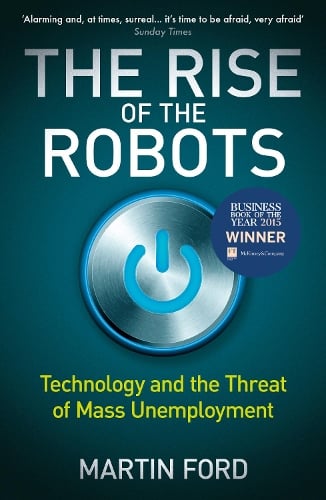
The Rise of the Robots

The Rise of the Robots cover
Good Books rating 4.12
Buy online
Technical
  • ID: 2674
  • Added: 2025-10-16
  • Updated: 2025-10-16
  • Formats: 1
  • Reviews: 4
Reviews
pumpjackpress.com · Unknown · 2019-02-27
terrifying 4.50

The Rise of the Robots by Martin Ford is a chilling exploration of how automation and AI threaten to eliminate jobs across various sectors, from manual labor to white-collar positions. The book argues that traditional solutions like education may not be enough to combat the economic upheaval caused by technological advancements, and suggests a basic income as a potential solution.

The Rise of the Robots by Martin Ford paints a stark picture of the future where automation and artificial intelligence are poised to disrupt the job market on an unprecedented scale. Ford meticulously examines how robotics and AI are already making inroads into sectors like fast food, retail, and even white-collar jobs, rendering many positions obsolete. The book highlights the grim reality that even with increased education and training, the shrinking number of jobs will leave many people behind, exacerbating wealth inequality and economic instability. The author suggests that a basic income could be a viable solution to ensure that the benefits of technological advancements are more equitably distributed, although the political climate makes such a solution seem unlikely. Overall, the book serves as a wake-up call to the impending economic challenges and the need for proactive measures to address them.


Quick quotes

    Almost all jobs are at risk, especially those that are highly repetitive, from fast-food workers (robotic hamburger machines) to drivers (self-driving taxis and trucks), and from retail (kiosks) to construction (3D printed buildings).

    Organizations are likely to flatten. Layers of middle management will evaporate, and many of the jobs now performed by both clerical workers and skilled analysts will be simply disappear … a start-up company based in the New York City area, offers an especially vivid example of the dramatic impact that white-collar automation is likely to have on organizations.

    The bottom line is that, rather than resulting in a nation of slackers, a well-designed guaranteed income has the potential to make the economy more dynamic and entrepreneurial.

ijhrdppr.com · Unknown · 2016-03-16
intriguing 4.50

The Rise of the Robots by Martin Ford explores the potential economic impact of automation and artificial intelligence, arguing that technological advancements could lead to massive unemployment and inequality. The book highlights how the benefits of the new economy are skewed towards a few, weakening middle-class demand and potentially causing the implosion of the consumer economy.

Martin Ford's The Rise of the Robots delves into the transformative effects of technology on the job market, suggesting that the current industrial revolution will not follow the same pattern as previous ones. As machines become more capable, fewer people will be needed, leading to the obsolescence of many 'good jobs' across various sectors. This shift could result in significant unemployment and widening inequality, further straining working and middle-class families. The book also addresses the rising costs in education and healthcare, which have not yet been significantly impacted by information technology. Ford urges employers, scholars, and policymakers to confront these challenges and consider the broader implications for economic prosperity and security. The book is a crucial read for anyone interested in understanding the future of work and the potential economic disruptions that lie ahead.


Quick quotes

    As labour becomes uneconomic relative to machines, purchasing power diminishes.

    At the same time, households are under assault from exploding costs, especially from the two major industries education and health care that, so far, have not been transformed by information technology.

    The result could well be massive unemployment and inequality as well as the implosion of the consumer economy itself.

theguardian.com · Unknown · 2015-10-01
intriguing 3.50

The Rise of the Robots by Martin Ford and Humans Need Not Apply by Jerry Kaplan explore the impact of advancing technology on employment, highlighting the potential for computers to outperform humans in various high-skill jobs. While both books present alarming scenarios of mass unemployment and increased inequality, they also offer nuanced perspectives that temper their initial gloomy predictions.

The Rise of the Robots by Martin Ford and Humans Need Not Apply by Jerry Kaplan delve into the transformative power of modern technology, particularly its impact on employment. Both authors, seasoned Silicon Valley experts, present a compelling case for the increasing capabilities of computers, which now possess the ability to learn and adapt independently. They argue that automation is not limited to manual labor but extends to high-wage, high-skill jobs, posing a significant threat to various professions, from finance to healthcare. The books are filled with fascinating facts about technological advancements, such as the exponential growth of computing power and the ability of computers to perform complex tasks like diagnosing medical conditions and writing articles. However, the authors also acknowledge the uncertainties and potential overstatements in their predictions. Ford, in particular, gradually introduces qualifications to his initial assertions, suggesting that the timeline for these changes might be much longer than initially thought. Kaplan, while more optimistic, also backtracks from some of his more alarming scenarios. Despite their occasional inconsistencies, both books provide a thorough and accessible introduction to the ongoing debate about the future of work in an increasingly automated world.


Quick quotes

    Computers have long outgrown this quaint summation. Instead, they can now work things out for themselves, proceeding by trial and error to develop their own programs according to their needs

    The machines are coming for the high-wage, high-skill jobs as well

    In his earlier, more confident chapters, he seems sure that, despite all those other premature warnings, this time computers really are poised for world domination.

goodreads.com · Unknown · 2015-05-05
intriguing 4.00

Martin Ford's 'The Rise of the Robots' argues that accelerating technology is fundamentally disrupting global employment, threatening both routine and predictable jobs. The book challenges the assumption that education and skills will protect against job automation, highlighting the impact on various sectors, including higher education and healthcare, and raising critical questions for the HRD profession.

Martin Ford's 'The Rise of the Robots' presents a compelling argument that accelerating technology is fundamentally disrupting global employment. The book challenges the pervasive view that education and skills will assure secure and prosperous futures, arguing that automation is threatening both routine and predictable jobs across various sectors. Ford's analysis is particularly pertinent to the HRD reader, as it questions the prevailing assumptions about education, training, and skills. The book also explores the implications for higher education and healthcare, noting that while these sectors have been more resistant to change, the impact of technology is inevitable. Ford's focus on developed economies, particularly the US and the UK, leaves a gap in considering the impact on developing economies, which is a notable oversight. Despite this, the book raises critical questions for the HRD profession, urging a re-evaluation of the relationship between HRD, job market polarization, and the future of work. Ford's insights are crucial for professionals in HRD, as they highlight the need to reconsider and reconfigure the challenges facing the field in light of technological advancements.


Quick quotes

    acquiring more education and skills will not necessarily offer protection against job automation in the future

    Ford’s book needs to be widely read by professionals working in HRD. If, as a result, the challenges facing HRD begin to be re-considered and re-configured Ford’s book will have been a contribution of some significance.

    The technology and the relative cost of the technology “will develop to the point where low wages no longer outweigh the benefits of further automation”.