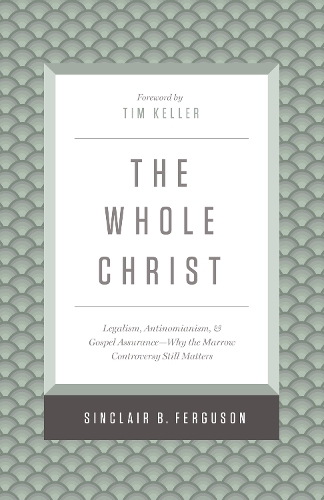
The Whole Christ: Legalism, Antinomianism, and Gospel Assurance—Why the Marrow Controversy Still Matters

The Whole Christ: Legalism, Antinomianism, and Gospel Assurance—Why the Marrow Controversy Still Matters cover
Good Books rating 4.33
Buy online
Technical
  • ID: 2351
  • Added: 2025-10-13
  • Updated: 2025-10-13
  • Reviews: 3
Reviews
sb.rfpa.org · Unknown · 2025-10-21
insightful 4.50

The Whole Christ by Sinclair Ferguson delves into the Marrow Controversy, addressing legalism, antinomianism, and gospel assurance. The book emphasizes the importance of understanding grace and union with Christ as the antidote to these distortions, offering valuable insights for evangelism and discipleship.

The Whole Christ by Sinclair Ferguson is a profound exploration of the Marrow Controversy, a historical debate in the Church of Scotland that remains relevant today. The book addresses the nuances of legalism and antinomianism, highlighting how both distort the true nature of God's grace. Ferguson argues that legalism separates God's law from His person, while antinomianism denies the role of the law in the Christian life. The antidote to both is a deep understanding of grace and union with Christ, which fosters genuine obedience and assurance. The book is not an easy read but is highly valuable for those involved in evangelism and discipleship, offering timeless insights into the gospel's transformative power.


Quick quotes

    On the surface the Marrow Controversy was about how we preach the gospel; what role, if any, God’s law and obedience play in the Christian life; and what it means to have assurance of salvation. But those issues are always, at bottom, about the gospel itself.

    Legalism is simply separating the law of God from the person of God.

    There is only one genuine cure for legalism. It is the same medicine the gospel prescribes for antinomianism: understanding and tasting union with Jesus Christ himself.

faithalone.org · Unknown · 2025-10-21
informative 3.50

The book explores the Marrow Controversy, a historical debate on the nature of salvation and the free offer of the gospel. The reviewer finds the book informative and relevant to modern debates, particularly between Free Grace and Lordship Salvation, but notes that the author's own theological biases occasionally cloud the presentation of the Marrow Men's views.

The Whole Christ by Sinclair B. Ferguson delves into the Marrow Controversy, a significant theological debate from the 18th century that revolved around the nature of salvation and the free offer of the gospel. The controversy began when William Craig, a candidate for ordination, refused to agree that forsaking sin was not a condition of receiving eternal life. This stance led to a broader discussion about the grace of God and how it should be preached. The Marrow Men, as they came to be known, believed that the gospel should be offered to all without exception, contrasting with other Calvinists who thought the gospel should only be offered to those showing signs of regeneration. The reviewer appreciates the book's relevance to modern debates, particularly the Free Grace movement, and finds it easy to read and informative. However, they note that Ferguson's own theological biases sometimes prevent him from fully exploring the implications of the Marrow Men's views. For instance, Ferguson disagrees with the Marrow Men's assertion that assurance is of the essence of faith, preferring a more traditional Reformed perspective that bases assurance on behavior rather than Jesus' promise of eternal life. Despite this, the book is valuable for its historical insights and its relevance to contemporary theological discussions.


Quick quotes

    The Marrow Men believed that “Christ is to be offered to all men everywhere without exception or qualification

    Whereas the other Calvinists made repentance “a qualification for grace,” according to the Marrow Men, “This puts the cart before the horse. It stands the gospel on its head so that the proclamation of the gospel, with the call to faith in Christ, becomes conditional on something in the hearer.

    Ferguson disagrees with the Marrow Men on that position. He distinguishes between believing in Christ (the “direct act”), and believing that you have believed in Christ (the “reflex act”),

kirkmillerblog.com · Unknown · 2021-02-18
excellent 5.00

The Whole Christ by Sinclair Ferguson is a theological exploration of the relationship between law and gospel, using the Marrow Controversy as a case study. It offers a deep dive into topics like legalism, antinomianism, and assurance, with a treatment that is both theologically astute and pastorally sensitive.

The Whole Christ by Sinclair Ferguson is a book that delves into the historical Marrow Controversy within the Scottish Presbyterian church of the early 18th century. This controversy serves as a lens through which Ferguson examines the complex relationship between law and gospel in the life of a believer. The book provides a thorough analysis of subjects such as legalism, antinomianism, and the assurance of salvation. Ferguson's approach is both intellectually rigorous and pastorally sensitive, making the book accessible and applicable to a wide range of readers. The treatment of these topics is not only theologically sound but also deeply practical, offering insights that can be applied to daily Christian living. This book is seen as a valuable resource that readers may want to revisit in the future to refresh their understanding and application of the gospel in their lives.


Quick quotes

    Ferguson uses the Marrow Controversy that occurred in the Scottish Presbyterian church during the early 18th century to illuminate and provide an excellent theological treatment on the classic issue of the relationship between law and gospel and their role in the life of the believer.

    This means he provides an analysis of subjects like legalism, antinomianism, and assurance.

    In some ways, you might think of this book as a deep dive into the topic “the gospel in the life of the believer” conducted through the lens of a particular historical case study.

    Ferguson’s treatment is both theologically astute and pastorally sensitive and applicable.

    This is one of those books I feel like I will want to return to and read again in years to come to refresh myself in the aid it supplies.