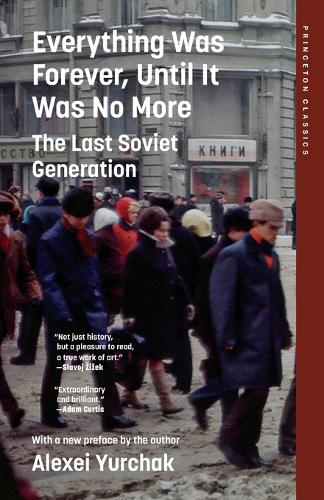
Everything Was Forever, Until It Was No More: The Last Soviet Generation

Everything Was Forever, Until It Was No More: The Last Soviet Generation cover
Good Books rating 3.83
Technical
  • ID: 11499
  • Added: 2026-03-09
  • Updated: 2026-03-11
  • ISBN: 9781400849109
  • Publisher: Princeton University Press
  • Published: 2013-08-07
  • Formats: 2
  • Reviews: 3

This book delves into the contradictions of Soviet life during the era of 'late socialism' (1960s-1980s), as seen through the lens of the last Soviet generation. It examines how the major transformations of the 1950s led to unexpected meanings, communities, and ideals, providing a nuanced understanding of a system often oversimplified as a dichotomy of official and unofficial cultures. /n/n Drawing on rich ethnographic material, the author offers an alternative model of Soviet socialism that acknowledges the genuine importance of its values and ideals to many citizens, despite their routine transgressions and reinterpretations of state norms. This work challenges binary accounts and offers a deeper, more complex view of life in the late Soviet period.

Reviews
The University of Chicago Press Journals · H. Murav · 2026-03-11
innovative 4.50

The book offers a new paradigm for analyzing Soviet culture from Stalin's death to the collapse in 1991. It goes beyond political and economic analyses to explore the cultural and social aspects of late Soviet life.

H. Murav's review praises the book for offering a new paradigm for analyzing Soviet culture from the death of Stalin to the collapse in 1991. They appreciate how the book goes beyond political and economic analyses to explore the cultural and social aspects of late Soviet life. Murav highlights the book's innovative approach and its ability to provide a comprehensive understanding of the era. They note that the book's focus on everyday experiences and cultural phenomena makes it a valuable contribution to Soviet studies.


Quick quotes

    Yurchak offers a new paradigm for the analysis of Soviet culture from the death of Stalin to the collapse in 1991.

    His work goes beyond political and economic analyses to explore the cultural and social aspects of late Soviet life.

    The book's focus on everyday experiences and cultural phenomena makes it a valuable contribution to Soviet studies.

The Storygraph · 2026-03-11
insightful 3.00

The book is an academic text with dense prose and jargon, but it provides valuable insights into late Soviet life. It's not for everyone, but it offers a unique perspective on the period.

This review highlights that the book is not for casual readers due to its academic nature and dense prose. However, it appreciates the book's ability to shed light on the paradoxes of late Soviet life. The reviewer acknowledges that while it may not be accessible to everyone, it offers a unique and valuable perspective on the last Soviet generation. They emphasize the book's academic rigor and the insights it provides into the complexities of Soviet socialism.


Quick quotes

    This is not a book for everyone — it is clearly an academic text brimming with jargon and dense prose.

    That being said, it did give insight into not only the peculiar experience of late socialism but also the broader implications of living under such a system.

    It's a challenging read, but those interested in Soviet history will find it rewarding.

London Review of Books · Sheila Fitzpatrick · 2006-05-25
engaging 4.00

The book delves into alternative lifestyles, Western fascination, and rock music in late Soviet society. It provides a nuanced understanding of the era through personal anecdotes and cultural analysis.

Sheila Fitzpatrick's review focuses on the book's exploration of alternative lifestyles, Western influence, and rock music in late Soviet society. She appreciates how the book uses personal anecdotes and cultural analysis to provide a nuanced understanding of the era. Fitzpatrick notes that the book's strength lies in its ability to capture the everyday experiences of the last Soviet generation, offering a rich tapestry of life under late socialism. She highlights the book's engaging narrative and its ability to make complex historical events relatable.


Quick quotes

    A good deal of Yurchak's story has to do with alternative lifestyles, fascination with the West, rock music and jokes: late Soviet phenomena that are vividly evoked.

    The book's strength lies in its ability to capture the everyday experiences of the last Soviet generation.

    Yurchak's engaging narrative makes complex historical events relatable.